Wednesday, October 31, 2012

Done Deal: Penguin/Random House Merger

Well, that didn't take long. Three days ago I saw the first article on this subject, and yesterday the merger was announced as a done deal between the two companies. Actually, the expected merger date is a year away, and there's plenty of time for public discussion/lawsuits to intervene, but it does seem that the merger will probably get pushed through. Since these two giant companies are not only competing with the other four corporations among the Big Six Publishers, but also the emerging powerhouses in digital publishing like Amazon, and Apple, the thing that might have prevented the merger—laws against restraint of trade—doesn't look real viable.

As this article in the New York Times points out, this is probably just the beginning of merger/consolidation in the publishing industry to deal with the changing market environment. Smaller publishers could get absorbed or squished (not NYT language—that's mine), but the article suggests that publishers with dedicated authors and readers might find niche markets and do okay.

In response to expressed concerns from literary agents and authors (and it took until yesterday for any of the articles to even mention authors, btw—literary agents were as far down the money chain as the business brains seemed to go when analyzing the merger talks), the new chief executive of the combined companies sought to offer reassurance as follows:


In an apparent effort to ease those concerns {of authors and literary agents}, Mr. Dohle on Monday sent letters to the author, agent and bookselling communities, seeking to reassure them how much a combined Penguin Random House would value them. “For us, separately and in partnership, it is and always will be about the books. Your books,” Mr. Dohle wrote in the message.
He said in the phone interview that the merger would not result in closing redundant imprints and less editorial independence. “The idea of this company is to combine the small company culture and the small company feeling on the creative and content side with the richest and most enhanced access to services on the corporate side,” Mr. Dohle said.

Considering that all the big publishers are owned by giant media companies, which seem totally focused on profits and, it could be argued, don't fully understand or care too much about the culture of books, it's a leap of faith to accept this statement as likely.

In a separate article a couple of days ago (before the merger went through), written for the British newspaper, The Telegraph, the idea that it might not be a bad thing in the long run for the merger to go through was explored thoughtfully. Essentially, the argument is that by creating the clout (through the merger) to fight back against Amazon's relentless policy of unsustainably low book prices, the important aspects that are traditionally available from the industry that are important to make a good book can be saved. In the long run, low low book prices will be as bad for consumers as they are for authors and the industry. This article is worth a read, because good points are made, and as authors it is in all our interests to be aware of the big picture, and to be able to use the information available to position ourselves as best as possible.

Bottom line of hope: we all know that there are many, many, wonderful book people out there still. Knowledgeable, committed, savvy. We're in the trenches, many not even one step removed any more as self-publishing grows, and we see the good guys as well as the disasters. Maybe with these new mega-market forces pushing publishers to fight for their businesses, some creative solutions will be supported and the good guys will win a few key battles. Let's hope so. Let's stay informed and active, and not sit silently on the sidelines to see what happens.

Monday, October 29, 2012

Setting and Characterization: Make Them Believable and Compelling With Specific Visuals

Readers love writers who write with knowledge, confidence, and authenticity. They love it when they know they're in good hands and the story is going to unfold with detail and believability as well as style. I love that when I'm reading. Who doesn't?

To write that way, we have to be inside our characters' heads, in the room they're in and in the world they're in, and we have to be able to bring those aspects alive. It sounds like a tall order, but there are methods to help us achieve this most important form.

In her book, A Writer's Guide to Fiction, well-known fiction editor Elizabeth Lyon explains the process for us. First of all, she points out that, "As writers, we are our readers eyes. Through us they visualize the setting, characters, and events, and in their mind's eye, readers connect images with emotions and realize an event's literal, as well as its symbolic, meaning." (p. 143)

How do we accomplish being our readers eyes? Through the use of visuals. Lyon argues that every style of writing requires  visuals, whether minimalist or any other. "As an editor, I see minimalist efforts that fall far short of Papa Hemingway's deft spartan style. I also see purple prose that would make Faulkner roll over in his grave. On the whole, though, most aspiring writers err on the side of too few visuals, especially ones selected for specificity, impact, and meaning. (p. 144) (emphasis added)

Specificity in description of setting or characterization is accomplished by avoidance of cliché, selection of concrete nouns (those that can be perceived through a sense organ—eyes, nose, skin, tongue. See 7/23 post: Strong Sentences, Concrete Nouns and Verbs for examples), and creation of an original perspective. (p. 144)

Here is an example that Lyon uses to show specificity of place, from Winterkill, by Craig Lesley, a novel that describes a former thriving Indian village:

Both the sky above the garage and the flat water of Celilo Lake had taken on a slate-gray color. The old village with its salmon-drying shacks and Wy-Am longhouse was gone now that the dam's backwaters had covered Celilo Falls and ended the fishing. Tommy Thompson's home was gone too. The old chief had painted his east door a bright salmon color to catch the sun's first rays each morning.

Yellow corrugated plastic sealed the east end of the new cedar-shake longhouse, and the same plastic covered the peak of the roof, although it had been nailed on earlier and had become faded with passing time . . . . Beside the longhouse, a utility pole had a lead wire strung to a bright blue-and-white Pepsi machine. 

This description is not cliché, it uses concrete nouns (Celilo Lake, salmon-drying shacks, east door a bright salmon color, etc.), and offers an original perspective (the contrast between the former thriving village and the current depressing one).

Here's what Lyon says: . . . The combination of all the visuals not only provides the reader with a clear sense of a place but also delivers a mood and meaning—I feel sad about the loss of an intact culture, distressed over the displacement of people and the incursion of the bright, cheery, Pepsi machine.

Less experienced writers often hurry through the setting or character description, perhaps taking half or three-quarters fewer words than Lesley used. But it is not quantity of description that dissuades a reader. Readers stay engaged by the specificity, impact, and meaning of those images.

The same sort of technique applies to characterization, but to keep this post at a manageable length, we'll leave that for another discussion another day.

My best writing teachers made a point of asking for more detail, more specificity of description, and that I slow down and give the space needed to accomplish these things. When we're caught up in telling a story, and focused on maintaining tension to keep the reader turning pages, it's sometimes difficult to remember how important specific visuals are for bringing the characters and settings to life—but definitely worth the effort!

Do you have examples from your work, or from writers you love, where specific visuals shine?

Friday, October 26, 2012

Random House and Penguin in Merger Talks

An article in yesterday's London-based Financial Times provides a peek at the initial stages of merger talks that are going on between two of the big six publishers—Penguin and Random House. The merger would, according to the article, "create a global market leader in response to the strategic challenges of the fast-growing e-book business."

This leaves me with all questions and no answers. If the merger goes through (and there's serious doubt about that at the moment, since restraint of trade might be raised as an issue), will the new company find a way to recapture the good parts of the traditional publishing industry? More editors; more opportunities for quality products through industry-based (i.e. editorial) attention; more marketing support; more depth of purpose regarding not only surviving and making a profit, but understanding the full market and establishing a stronghold where authors can rely on the system? If wishes were horses . . .

Could this be a beginning, or might it be an end, or just more of the same with a larger corporation? Will this matter to anyone who is not part of these two giant companies? What are your thoughts?

Wednesday, October 24, 2012

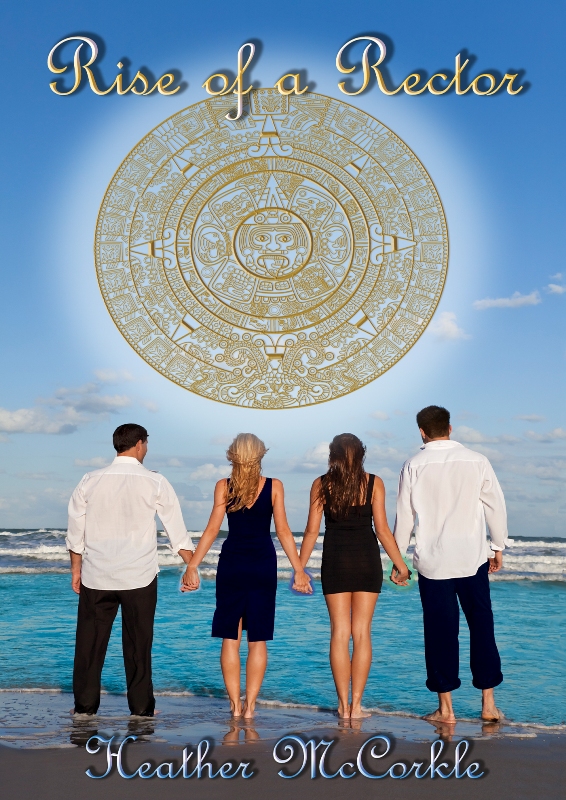
Heather McCorkle's blog tour: RISE OF A RECTOR Is Released!


The final novel in Heather McCorkle’s channeler series, Rise of a Rector, has released! To celebrate, and in the spirit of October, Aunt Sylvia from the channeler series is here to tell us about a scary moment in her life. Take it away Sylvia!

Sylvia: Our enemies came knocking one night after they had severely wounded my niece, Eren. They attacked us in our own home, both me and my husband. Knowing Eren and my son were just upstairs, I fought ruthlessly. These people had killed members of my family before, I wasn’t about to let them do it again. When I turned around though, Eren and my son were there, in harm’s way. I fought all the harder but there was no need. Eren and my son proved that they had the legendary fighting blood of our ancestral line running through their veins. They overcame our enemy alongside me.

Check out Heather’s blog for a new tour stop each day until November 2nd. To thank her fans, and future fans, Heather’s historical fantasy novel (a standalone novel that ties into the channeler series) will be free Friday November 2nd and Saturday November 3rd on Amazon. And if Heather gets over 1000 downloads of To Ride A Puca in those two days she’ll give away a $10 Amazon or B&N gift card! So spread the word, get ready to download To Ride A Puca, tell all your friends to download it, and drop by Heather’s blog now to enter to win the gift certificate.

You can find all three novels in the channeler series (The Secret of Spruce Knoll, Channeler’s Choice, and Rise of a Rector) on Amazon and B&N, as well as other retail sites. The channeler novella~and prequel to The Secret of Spruce Knoll~Born of Fire is currently free on Amazon and B&N and you can find a short story about Fane from the series in the FREE anthology, In His eyes. You can add Rise of a Rector to your Goodreads lists at this link.

A final note from me (Linda): many of you know Heather from all the great work she does with social media and cover design, as well as her writing, and how supportive she always is of other writers. It's a pleasure for me to get to help get the word out about her terrific (!) trilogy, and give just a tiny bit back to her for her constant generosity. Thanks, Heather, you rock!! :))

Monday, October 22, 2012

Finding Good Words


One of the changes in writing practices that has come with the internet is easy access online to dictionaries and thesauruses, both of which are indispensable to a fiction writer.

One of the drawbacks of that, in this writer's opinion, is that it's easy to slip into laziness about really searching out words that are not only not cliché, but have the rich background meanings that are just right for the nuances we're trying to convey with our most important tool: our word choices.

I have to admit I'm guilty of not consulting the best sources as often as I need to. I own a copy of the American Heritage Dictionary, the Oxford Desk Dictionary and Thesaurus (American Edition), and a copy of OED's sister volume on the origins and development of words, the Oxford Etymology. But do those august volumes do me any good sitting prettily on my writing shelf?  Nooooo. These days I seem to expect that the computer should be smart enough to read my needs and give me a pop-up window with all the very best choices as soon as I think, hmmmm, what word would work best here?

Priscilla Long has a few bon mots to say on the subject of using good resources to find your most effective words. In The Writer's Portable Mentor she has a section on where to find good words. Here's what she says (pp.  26-28):

No writer should be without a Very Large dictionary. Would you hire a carpenter to build you a house who had for tools a single pair of pliers? Would you begin a cross-country road trip with one gallon of gas in the tank? No, you wouldn't, but many writers go for years with nothing more in hand than their little college dictionary. (Online app dictionary and thesaurus, anyone?)

Here are the reference books Priscilla Long recommends, with a couple of my own favorites thrown in.

for the true fanatic: Webster's New International Dictionary, Second Edition, Unabridged, 1934 copyright. (otherwise, a good, more standard Very Large dictionary will do.) Extra words at the bottom of the pages, and elaborate illustrations for many words.

The Oxford Dictionary of the English Language. This dictionary traces a word back to when it first entered English [and] gives instances of a word's use from it's earliest appearance to the present. (you can access this dictionary online at the Seattle Public Library so it's worth a try to find it at your own local library.)

At least one ample, argumentative grammar-and-usage book . . . since most dictionaries describe but do not prescribe. Usage manuals prescribe. They fight to maintain the difference between ensure and insure, between that and which . . . They insist that And and But are excellent ways to begin a sentence . . . A Dictionary of Modern English Usage by H.W. Fowler is an entertaining read. For contemporary work, I would not be without my Garner's Modern American Usage by Bryan A. Garner. (Personally, I prefer the Chicago Manual of Style. It is an invaluable resource for these types of issues.)

It is also essential to have a grammar book. One I like is The Deluxe Transitive Vampire by Karen Elizabeth Gordon. (Whoa! I never heard of this one before. Am going to have to check it out.)

Finally, Long closes with this insightful, practical and easy-to-use piece of advice:

What guidebooks are to the world traveler, dictionaries, grammars, and usage manuals are to the writer. But gathering words should take you beyond these reference works to other compendiums of words. (My emphasis.) Clothing catalogs name clothes (chinos, cords, boot-cut jeans). Tool catalogs—try leevalley.com—name tools (ripsaw, bucksaw, coping saw, band saw). Go to an art store for types of brushes and names of pigments (bone black, burnt umber). Go to the United States Geological Survey for geographical features such as shrub-steppe, bog, or slough and for spooky proper names such as the Great Dismal Swamp. You get the idea.

Yes, we do, Priscilla. Thank you!!!

Monday, October 15, 2012

Long-Haul Writing Career: What It Takes To Succeed

We all want to be excellent writers, don't we? We really don't want to be mediocre. That doesn't mean we have to write Pulitzer-Prize-winning prose, and it doesn't mean that one genre is better than another. It does mean we want to be professional and better than work-a-day in our skill set and our skill level. Almost nobody starts off being excellent. As James Scott Bell, a great writing teacher, speaker, and prolific writer himself, points out, talent is necessary, but it's the least important of the skills required to become a successful writer. We can learn what we need to know.

In one of my favorites of Bell's writing books, The Art of War for Writers, there's a workbook chapter on what it takes to make it as a writer over the long haul. Bell lists ten necessary characteristics, which I've produced below. Plus, in his book, there's a follow-up question section of questions/statements where you write in your own personal responses to determine where you might need to adjust your attitude or whether you're off and running in the right direction.

Here are the ten characteristics and what Bell says about them (The Art of War for Writers, pp. 11-13) :

  1. Desire. It's got to be a hunger inside you. You're going to have to sacrifice time and money and endure frustrations galore. If you don't have the desire, you won't last long out there on the battlefield.
  2. Discipline. It's all about production. A quota of words, six days a week.
  3. Commitment to Craft. You can't just dash off a book. Leonard Bishop wrote, "Dramatic characters, inventive plotlines, exciting and intense situations are not achieved through accident or 'good luck.' The writers of great books zealously learn the craft of their profession so they can release the power and depth of their imagination and experience."
  4. Patience. It takes time. But you can cut down the time if you have 1, 2, and 3.
  5. Honesty. Be willing to confront your weaknesses as a writer.
  6. Willingness to Learn. No chip on your shoulder. Check your ego at the door, or wherever else is convenient.
  7. Business-Like Attitude. Develop business savvy and professionalism.
  8. Rhino Skin. Learn from every rejection, and never let any rejection hold you back.
  9. Long-Term View. Don't think: "Do I have a book inside me?" Think: "Do I have a writer inside me?" And answer: "Yes!"
  10. Talent. The least important. Everyone has some talent. It's what you do with it that counts.
So, I know you were measuring yourself against each of these ten points. How'd you do? That business about being honest about your weaknesses, plus, at the same time, never letting rejection hold you back, is where a lot of us get caught up in our own fear of failure. So, of course, actually paying attention to these things and working at them consciously (if these are areas that resonate) can be the key to breaking through from average writing to great writing.

Which of these ten points resonates most with you? Or are there others?