Monday, August 19, 2013

How Good is Your Attention Capability? (It's Often Key to Good Writing)

I love positive brain games, and I've been playing them on a fabulous site for optimizing brain function called Lumosity. Go to their site to learn about the company (excellent bona fides) and sign up if you're interested (I can't put a link in this post because for some reason, every time I try, it goes to my own lumosity activity instead of the basic site--hmmm, maybe these brain science geniuses need to do a few tech tweaks!)

Anyway, within the categories of brain activity I selected that I want to focus on (problem solving, flexibility, memory, acuity, etc.) is Attention, which is consistently THE hardest category for me.

I live in my head a lot, like many other writers. I've known all my life that when I walk down a city street, I'm totally aware of the ambiance, the energy, the colors and sounds, and the light or dark feeling that surrounds me in an aura-ish, or a gestalt-ish way, and I can reproduce that feeling in words.  But if you ask me where a particular shop is that I walk past every day, I probably don't even know that it exists, much less where it is on the street. 

I've considered asking the government if I can get disability payments for this inability (along with some $$ for the no-sense-of-direction problem that also just has to be a physical, neurotransmitter glitch in my brain), but have decided to just work on it to improve it instead.

One of the reasons I want to improve my Attention Capability is that it is so important to notice physical details and retain them for authentic writing. Not just for description of place, but for context in characters' reactions and feelings. Names of shops and their physical appearance, for example, can have power and meaning in the context of a character's experience. 

Of course you can take pictures to help you remember later, but that doesn't have the emotional immediacy of noting the meaning to you in the moment, or the specific feeling that particular name or shopfront or outfit a person is wearing creates in you that is memorable. Real details can be SO powerful when it comes to conjuring experiences and feelings on the page.

This week, at the Brainpickings Weekly site, there's a wonderful article on Attention, called The Art of Looking: What 11 Experts Teach Us about Seeing Our Familiar City Block with New Eyes. Annie Dillard is quoted, beautifully lamenting how urban living can rob us of this key element in experiencing life and expressing in words how that feels, but the article also offers an endorsement of a book that can help us open our eyes to what learning to pay attention to details will do for us:


“The art of seeing has to be learned,” Marguerite Duras reverberates – and itcan be learned, as cognitive scientist Alexandra Horowitz invites us to believe in her breathlessly wonderful On Looking: Eleven Walks with Expert Eyes (public library) – a record of her quest to walk around a city block with eleven different "experts," from an artist to a geologist to a dog, and emerge with fresh eyes mesmerized by the previously unseen fascinations of a familiar world. It is undoubtedly one of the most stimulating books of the year,


It does look like a beautiful book, on a subject that is important to any writer (especially if you live in an urban location and also mostly in your head!)

Do you notice all the details of your environment or no? Are you aware of how you use these kinds of details in your writing? What do they do for you??

Monday, August 12, 2013

Using Social Media's Marketing Data to Sell Books


"As publishers realize—or perhaps more accurately stated—embrace the fact that they must demonstrate to authors and retail partners that they are the best at connecting books with readers and driving demand, the question becomes how to do so. It is difficult for me to think of any other efforts publishers can employ that will yield the insights and long-lasting audience development of social media. Very Difficult."

Those are the concluding words of Peter McCarthy in an article (Five Reasons Social Media Will Always Sell More Books. . .) that he wrote that was published on Digital Book World's site July 31. McCarthy is a social media pro who used to work for Random House (Marketing Innovation) ad for Penguin Group, USA, Online (VP). He makes a strong case for social media as a book marketer's core. Here are the five reasons he lists:
  1. The Core Book-Buying Audience Uses Social Media (and so do all those other folks who will buy books if they hear about them…)
    This is true unless your audience falls outside of the 85% of the U.S. population that uses social media or isn’t between the ages of 18 and 65+. Check the most recent Pew stats. Perhaps even bump them against some book industry studies. The audience is there. Fish where the fish are.
  2. Real Consumer Data
    The audience data that marketers, publicists, and salespeople can gather about social media followers, fans, and general users should be invaluable to anyone marketing or selling books. Acting on an understanding of the demographics, psychographics, and behavior of an audience with regard to an author, a title, or a site will grow sales and marketing efficiency. If it doesn’t, then something else is very wrong. Gathering and acting on data certainly helped Obama whip Romney. And it can even be predictive (Holy Grail!); in 2010 a couple smart HP researchers predicted opening box office using Twitter volume and sentiment along with number of screens. They did so with 97% accuracy.
  3. Identifying Adjacent Audiences
    Once you’ve analyzed your core audience, it quite straightforward to identify key attributes of that audience and find “look-alikes.” In other words, folks with similar key attributes (hobbies, beliefs, activities, likes, dislikes, locales, marital status, education level, etc.) and place your book in front of those folks who, it happens, will behave much like your core. This is the social graph and it is major.
  4. SEO
    This could be an essay. Short, over-simplified version focusing on two key points: 1) Both the “general” engines such as Google and the more-specific engines (eg. Amazon) use social “signals” to assist them in determining the authority of everything – including authors and books. Authority=rank. So, positioning. If the title holds up (eg. garners clicks and/or more links over time), it will retain that rank or rise… and 2) As a corollary; an author or title’s presence on the major networks will nearly always enter the first page of a Google search for the author, title, and even some of the longer tail terms. Ranking higher in search sells books; ask Google or Amazon.
  5. Making the Next Campaign Easier
    We hear a lot of talk about scaling marketing efforts. Social is often seen as a hurdle to scale. Social is actually scalable using technology. But it doesn’t really matter if the “IT” hurdle is too great; scale is inherent in using social to market. A marketer’s ability to look at the performance indicators and underlying consumer data of past social campaigns will increase her understanding of what works, for what, and how well. Also, what doesn’t work. This will speed and hone her next efforts. Every time. Knowledge, process, and a better “feel for the game” is scale. Lather, rinse, learn, repeat. Scaled marketing sells more books.
This makes good sense to me, and makes me want to know more about how, exactly, to get my hands on this kind of data, or how to ask a publisher if they are doing this (and know from their answer if they are doing it well). Check out the bottom of the article—McCarthy is going to be making a presentation at DBR's upcoming conference in NYC. Could be interesting!

Wednesday, August 7, 2013

Online Book Buying Grows

No big surprise—buying books online continues to increase. That refers to both paper and e-books. Here are some statistics from Bowker, just published in Shelf Awareness. The lag time in reporting means things have probably changed a bit since these were current, but the trend is clear, and interesting.

Interesting that e-books account for only 11% of spending. I thought that would be higher. And the other surprise for me was the genres that sell best as e-books, particularly mysteries. Hmm. Food for thought!

From Shelf Awareness Pro, 8/7/13:

Consumer Spending: Online Sales Keep Growing
Among findings from the 2013 U.S. Book Consumer Demographics and Buying Behaviors Annual Review, published by Bowker Market Research and Publishers Weekly:
  • In the year after Borders's closing, online retailers' share of the market rose to 44% in 2012 from 39% the previous year.
  • Women increased their lead over men in book buying, accounting for 58% of overall book spending in 2012, up from 55% in 2011. However, men bought more hardcovers, the only area where their buying outpaced women's.
  • The slowly improving economy is slowly improving the climate for purchasing books. By the end of 2012, 53% of consumers said the economy was having no effect on their book buying habits, up from 51% at the end of 2011.
  • E-books continued to rise in popularity, accounting for 11% of spending in 2012, compared to 7% in 2011.
  • E-books were most popular in fiction, particularly in the mystery/detective, romance and science fiction categories.
  • Traditional print book output grew 3% in 2012, to 301,642 titles.

Saturday, July 20, 2013

What Is Beautiful Writing?

We all want to write beautifully. We know beautiful writing when we read it, but being able to do it is a whole different animal. What, exactly, is it? Is it lyricism? Is it simplicity? Is it dramatic, deep insight?

For me, beautiful writing can be summed up in one word: heartfelt. Any of those things above (and plenty of others) can be beautiful if they meet this criterion.

When the writing reflects a natural, deep, organic connection to the feeling the writer is attempting to express, it's incredible.

Not too many people achieve that, at least not consistently.

We are self-conscious about our words, not wanting to sound too sentimental or too unsophisticated. We massage our words to make them better and better, and sometimes the effect is just the opposite—they lose resonance because the 'heartfelt' has been massaged right out of them.

Maybe, as adults who work at being writers, we need to go through this stage to come out the other side where we can reach for fewer and more succinct words that beautifully express our most heartfelt feelings and ideas. The way we would have done when we were very young.

Below is a short piece of prose poetry that shows what I mean about heartfelt writing far better than I can describe. It was published by Seattle Arts and Lectures along with pieces from other children and teens in their Writers in the Schools Program.

The author is Harlow C. Knoerlein, 3rd Grade, B.F. Day Elementary School.


DEAR ARTIST

     When you draw my portrait, do it with colored pencils. Draw me in the sand with my hair flying in the wind and waves crashing down on rocks. Draw me wearing a light blue long silky gown with a tiny bit of ruffles at the end. Draw the sun setting on the ocean. Draw the artist's name in the sand. Draw flowers flying in the wind.
     Please don't change anything about my face.
     Draw me running in the sand, with all the crabs crawling right next to me. Draw me singing, and the ocean singing with me.

     Sincerely,

     Harlow

I don't know about you, but I'd like to take a page out of Harlow's book, and let my writing be as fresh and immediate and heartfelt as this. I noticed that, in the publication this was in (IN THE SLIVER OF A SECOND), even the 8th and 9th graders had become self conscious, even when their writing was really, really good. And that's when it hit me that finding our authentic voice as a writer might just require finding a way to let go of what we think we've learned about life, love, loss etc., so we can burrow down to our most authentic selves.

What do you think? And, do you have favorite beautiful writers?

Monday, July 15, 2013

Elizabeth George's Writing Process: From Idea to First Draft

I just listened to Elizabeth George speak about writing. She was the featured speaker at a wonderful brunch held each year by the Seattle7Writers—a collective of (now about 60) well-published Northwest authors devoted to promoting literacy in their communities. The brunch is held to raise money for literary support for young writers in underprivileged circumstances, and is always fun and enlightening.

Elizabeth George is the author of the famous Thomas Lynley crime novels set in England that were made into a PBS series. Since the brunch audience was made up of book groups, writers, and others involved in the book business, she answered a question that is often asked of her: how does she go about writing her novels?

Her process (I'm liberally paraphrasing and interpreting here, because I did not take detailed notes!):

1. Every author, she says, first "is struck" by something—something in the news, something in their community, an idea, that rivets them. So, the first thing that happens for her when she's going to write a new novel is that she's struck by something that she wants to write about.

2. Once she has the idea, she focuses on place. For her, that involves going to that place and doing voluminous picture-taking, exploring, focusing on physical detail, and asking the place to speak to her--to tell her what there is about it that she will include in her story. She claims to be seriously unimaginative and so finds it critical to get as much concrete detailed info as she can for her story development.

3. The third step, which she might do on the airplane home or shortly thereafter, is to write up a short statement of what the book is about—about a page long.

4. Next come the characters. She jots down a list of characters who would be involved in the story. This first list is broad, and characters might be identified loosely, like witness one—milkman, witness two—mailman, investigators—police sergeant and inspector, etc. There may be fifteen or so characters on this list, who would be involved in the crime, the investigation, the subplots, etc.

5. She develops the characters in more detail—writes briefs on them and their involvement in the story she's writing, including some quick scenes. From this she is able to identify which of the characters are the strongest and will become the main characters in the book.

6. She writes brief descriptions of many or most of the scenes that will make up the story, including subplot scenes. Included are things like who's in the scene and what happens. She lets the characters tell her those things, rather than controlling the characters. They are the source of the storyline at this point.

7. From this she develops a quite detailed outline of the entire book.

8. Now, she feels secure in where she is in her story development and can finally do what she loves, which she says is the part where her soul gets involved and soars—she writes the first draft.

It's always fascinating to me to listen to authors talk in such detail about their writing process. Writers are all over the place on this topic, from not being able to write a story if they know what's coming next, to not being able to write a story if they don't know everything that's going to happen before they start.

I'm in between, and find that detailed outlining ahead of time totally kills my creative process—I've tried several times because authors I admire sing the praises of detailed outlining. It just doesn't work for me. But knowing some detail ahead of time is HUGE for me. It helps me visualize all sorts of scenes and interactions.

So a couple of the things Elizabeth talked about really spoke to me: exploring place in detail to obtain concrete information on the setting you're going to write . . . ruminating on those concrete details and letting them speak to you; and I also love that idea of sketching out all the characters you can think of that might be in your story and then developing their involvement in plot/subplot lines before you decide where the story is going. Let them tell you where it's going.

Are there things in Elizabeth George's process that you find work for you?


Monday, July 8, 2013

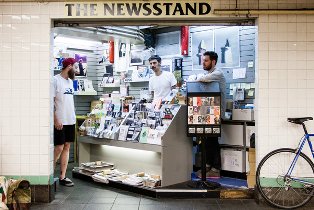
Subway Pop-Up Newsstand

I read a lot of trade press these days, just trying to keep apprised of what's happening in the book business and aware of the important issues affecting writers and readers.

My top news item pick for the past week is a brief on one of the most innovative and promising developments I've seen: pop-up newsstands. It's like a grown-up version of the neighborhood lemonade stand we all had as kids. The stars in our eyes back then were powered by mom and dad's generous support and our own entrepreneurial fantasies.

But this new development could actually have profitable legs for all involved (and serve a need), as long as participants stay satisfied with 'small.' As in small space, small number of offerings (but well-chosen for target customers), small time commitment in leases, small, shared profits. Awesome.

from shelf awareness.com pro, July 3, 2013:

Brooklyn Gets Pop-Up Subway Bookshop

Newsstand staffers Eddie Goldblatt, Lele Saveri and Jamie Falkowski.
photo: Robert Wright/NYT
The Newsstand, a pop-up shop located at the Metropolitan Avenue subway station in the Williamsburg section of Brooklyn until July 20, "has transformed an ordinary subway space into a store for independently published magazines, books, comics and zines. In a digitalized world, it is a small haven for printed media," theNew York Times reported.

Offering "a kind of 'staff picks' for the tight space," the Newsstand carries selections from McNally-Jackson Books in SoHo,Dashwood Books on the Lower East Side of Manhattan, the Desert Island bookstore in Williamsburg and Ohwow in Greenwich Village, the Times wrote. The shop, which opened June 15, splits profits with the bookstores.

"I was trying to find a way of supporting that scene without stepping on their toes," said manager Lele Saveri of the stores he asked to participate.

Although the Metropolitan Transportation Authority usually leases spaces by the year, it was open to a short-term tenant for the Newsstand. "They had an interesting and innovative proposal for how to have an amenity in there for our customers and generate a little revenue for us," said Adam Lisberg, an authority spokesman.


Have you seen anything like this? If you live in Williamsburg, Brooklyn, or nearby, have you perchance seen this one? Would love to hear about it!

Monday, June 24, 2013

First-to-Read Program from Penguin; Amazon Pays Advances

Some interesting things are happening in the publishing world these days. Following are two items that were publicized in the past week that give me hope that some of the kinks are being worked out in what has been a huge disruption in the publishing industry. Are traditional publishers and non-traditional publishing taking steps toward each other?

Item One: from Penguin
Penguin is an intriguing publishing company. They seem more 'out there' than the other big publishers,  testing the edges, pushing the envelope, checking out market possibilities that are outside the square old publishing box. Of course, they've done plenty of not-so-enlightened things lately, too (remember the library e-book lending kerfuffle?) But the company does seem to have a history of proactive marketing in some key areas, from the creation of the soft-cover paperback a long time ago, to the following.

Shelf-awareness.com, a great daily literary trade and reader report, published the following article last week about Penguin's new First to Read program, which not only focuses on utilizing social networks to get readers to spread the word about books Penguin publishes, but offers the tantalizing chance for participants not only to get excerpts of upcoming books (Penguin has been doing this a while through email subscriptions), but access to digital galleys. Wow. Zingy.


6/19/13 issue of Shelf-awareness.com 
Penguin Launches 'First to Read' Program for Consumers
Penguin Group (USA) is launching First to Read, a program offering readers free excerpts from books months before they are available for sale, as well as potential access to digital galleys. Describing the initiative as part of its "ongoing efforts to increase book discoverability and engage with readers," Penguin said it hopes to harness the power of word-of-mouth by offering members an opportunity to share news and information about books through their connected social networks. First to Read also includes a loyalty program that awards members points for their participation that can be redeemed for guaranteed galley access and other perks.

"First to Read is a program created for all readers, providing exclusive, early access to our upcoming books," explained Suzie Sisoler, senior director of consumer engagement. "We know people love to talk about and recommend the books they've read and are reading, and to encourage that, we've integrated social sharing throughout the site."


I don't know about you, but I find this impressive—whether it turns out to be a success or not. Penguin is accessing social media in creative ways, recognizing and utilizing the power the internet has given grass-roots efforts through social media connections.

Item Two: from Amazon
Amazon has started to pay decent advances and provide substantial editing, cover design, and marketing support for some top selections in their Amazon-published titles. And this includes titles that were initially self-published, then picked up by Amazon Publishing.

Between this and Penguin's news, I'm starting to wonder if the shakeout in the publishing industry is finally beginning to find a shape that might work. Wishful thinking probably, but these two developments do seem to have popped out as both pragmatic for readers and writers and clever from a marketing viewpoint.

What do you think?