Saturday, July 20, 2013

What Is Beautiful Writing?

We all want to write beautifully. We know beautiful writing when we read it, but being able to do it is a whole different animal. What, exactly, is it? Is it lyricism? Is it simplicity? Is it dramatic, deep insight?

For me, beautiful writing can be summed up in one word: heartfelt. Any of those things above (and plenty of others) can be beautiful if they meet this criterion.

When the writing reflects a natural, deep, organic connection to the feeling the writer is attempting to express, it's incredible.

Not too many people achieve that, at least not consistently.

We are self-conscious about our words, not wanting to sound too sentimental or too unsophisticated. We massage our words to make them better and better, and sometimes the effect is just the opposite—they lose resonance because the 'heartfelt' has been massaged right out of them.

Maybe, as adults who work at being writers, we need to go through this stage to come out the other side where we can reach for fewer and more succinct words that beautifully express our most heartfelt feelings and ideas. The way we would have done when we were very young.

Below is a short piece of prose poetry that shows what I mean about heartfelt writing far better than I can describe. It was published by Seattle Arts and Lectures along with pieces from other children and teens in their Writers in the Schools Program.

The author is Harlow C. Knoerlein, 3rd Grade, B.F. Day Elementary School.


DEAR ARTIST

     When you draw my portrait, do it with colored pencils. Draw me in the sand with my hair flying in the wind and waves crashing down on rocks. Draw me wearing a light blue long silky gown with a tiny bit of ruffles at the end. Draw the sun setting on the ocean. Draw the artist's name in the sand. Draw flowers flying in the wind.
     Please don't change anything about my face.
     Draw me running in the sand, with all the crabs crawling right next to me. Draw me singing, and the ocean singing with me.

     Sincerely,

     Harlow

I don't know about you, but I'd like to take a page out of Harlow's book, and let my writing be as fresh and immediate and heartfelt as this. I noticed that, in the publication this was in (IN THE SLIVER OF A SECOND), even the 8th and 9th graders had become self conscious, even when their writing was really, really good. And that's when it hit me that finding our authentic voice as a writer might just require finding a way to let go of what we think we've learned about life, love, loss etc., so we can burrow down to our most authentic selves.

What do you think? And, do you have favorite beautiful writers?

Monday, July 15, 2013

Elizabeth George's Writing Process: From Idea to First Draft

I just listened to Elizabeth George speak about writing. She was the featured speaker at a wonderful brunch held each year by the Seattle7Writers—a collective of (now about 60) well-published Northwest authors devoted to promoting literacy in their communities. The brunch is held to raise money for literary support for young writers in underprivileged circumstances, and is always fun and enlightening.

Elizabeth George is the author of the famous Thomas Lynley crime novels set in England that were made into a PBS series. Since the brunch audience was made up of book groups, writers, and others involved in the book business, she answered a question that is often asked of her: how does she go about writing her novels?

Her process (I'm liberally paraphrasing and interpreting here, because I did not take detailed notes!):

1. Every author, she says, first "is struck" by something—something in the news, something in their community, an idea, that rivets them. So, the first thing that happens for her when she's going to write a new novel is that she's struck by something that she wants to write about.

2. Once she has the idea, she focuses on place. For her, that involves going to that place and doing voluminous picture-taking, exploring, focusing on physical detail, and asking the place to speak to her--to tell her what there is about it that she will include in her story. She claims to be seriously unimaginative and so finds it critical to get as much concrete detailed info as she can for her story development.

3. The third step, which she might do on the airplane home or shortly thereafter, is to write up a short statement of what the book is about—about a page long.

4. Next come the characters. She jots down a list of characters who would be involved in the story. This first list is broad, and characters might be identified loosely, like witness one—milkman, witness two—mailman, investigators—police sergeant and inspector, etc. There may be fifteen or so characters on this list, who would be involved in the crime, the investigation, the subplots, etc.

5. She develops the characters in more detail—writes briefs on them and their involvement in the story she's writing, including some quick scenes. From this she is able to identify which of the characters are the strongest and will become the main characters in the book.

6. She writes brief descriptions of many or most of the scenes that will make up the story, including subplot scenes. Included are things like who's in the scene and what happens. She lets the characters tell her those things, rather than controlling the characters. They are the source of the storyline at this point.

7. From this she develops a quite detailed outline of the entire book.

8. Now, she feels secure in where she is in her story development and can finally do what she loves, which she says is the part where her soul gets involved and soars—she writes the first draft.

It's always fascinating to me to listen to authors talk in such detail about their writing process. Writers are all over the place on this topic, from not being able to write a story if they know what's coming next, to not being able to write a story if they don't know everything that's going to happen before they start.

I'm in between, and find that detailed outlining ahead of time totally kills my creative process—I've tried several times because authors I admire sing the praises of detailed outlining. It just doesn't work for me. But knowing some detail ahead of time is HUGE for me. It helps me visualize all sorts of scenes and interactions.

So a couple of the things Elizabeth talked about really spoke to me: exploring place in detail to obtain concrete information on the setting you're going to write . . . ruminating on those concrete details and letting them speak to you; and I also love that idea of sketching out all the characters you can think of that might be in your story and then developing their involvement in plot/subplot lines before you decide where the story is going. Let them tell you where it's going.

Are there things in Elizabeth George's process that you find work for you?


Monday, July 8, 2013

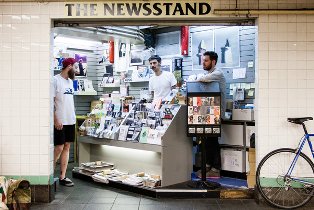
Subway Pop-Up Newsstand

I read a lot of trade press these days, just trying to keep apprised of what's happening in the book business and aware of the important issues affecting writers and readers.

My top news item pick for the past week is a brief on one of the most innovative and promising developments I've seen: pop-up newsstands. It's like a grown-up version of the neighborhood lemonade stand we all had as kids. The stars in our eyes back then were powered by mom and dad's generous support and our own entrepreneurial fantasies.

But this new development could actually have profitable legs for all involved (and serve a need), as long as participants stay satisfied with 'small.' As in small space, small number of offerings (but well-chosen for target customers), small time commitment in leases, small, shared profits. Awesome.

from shelf awareness.com pro, July 3, 2013:

Brooklyn Gets Pop-Up Subway Bookshop

Newsstand staffers Eddie Goldblatt, Lele Saveri and Jamie Falkowski.
photo: Robert Wright/NYT
The Newsstand, a pop-up shop located at the Metropolitan Avenue subway station in the Williamsburg section of Brooklyn until July 20, "has transformed an ordinary subway space into a store for independently published magazines, books, comics and zines. In a digitalized world, it is a small haven for printed media," theNew York Times reported.

Offering "a kind of 'staff picks' for the tight space," the Newsstand carries selections from McNally-Jackson Books in SoHo,Dashwood Books on the Lower East Side of Manhattan, the Desert Island bookstore in Williamsburg and Ohwow in Greenwich Village, the Times wrote. The shop, which opened June 15, splits profits with the bookstores.

"I was trying to find a way of supporting that scene without stepping on their toes," said manager Lele Saveri of the stores he asked to participate.

Although the Metropolitan Transportation Authority usually leases spaces by the year, it was open to a short-term tenant for the Newsstand. "They had an interesting and innovative proposal for how to have an amenity in there for our customers and generate a little revenue for us," said Adam Lisberg, an authority spokesman.


Have you seen anything like this? If you live in Williamsburg, Brooklyn, or nearby, have you perchance seen this one? Would love to hear about it!

Monday, June 24, 2013

First-to-Read Program from Penguin; Amazon Pays Advances

Some interesting things are happening in the publishing world these days. Following are two items that were publicized in the past week that give me hope that some of the kinks are being worked out in what has been a huge disruption in the publishing industry. Are traditional publishers and non-traditional publishing taking steps toward each other?

Item One: from Penguin
Penguin is an intriguing publishing company. They seem more 'out there' than the other big publishers,  testing the edges, pushing the envelope, checking out market possibilities that are outside the square old publishing box. Of course, they've done plenty of not-so-enlightened things lately, too (remember the library e-book lending kerfuffle?) But the company does seem to have a history of proactive marketing in some key areas, from the creation of the soft-cover paperback a long time ago, to the following.

Shelf-awareness.com, a great daily literary trade and reader report, published the following article last week about Penguin's new First to Read program, which not only focuses on utilizing social networks to get readers to spread the word about books Penguin publishes, but offers the tantalizing chance for participants not only to get excerpts of upcoming books (Penguin has been doing this a while through email subscriptions), but access to digital galleys. Wow. Zingy.


6/19/13 issue of Shelf-awareness.com 
Penguin Launches 'First to Read' Program for Consumers
Penguin Group (USA) is launching First to Read, a program offering readers free excerpts from books months before they are available for sale, as well as potential access to digital galleys. Describing the initiative as part of its "ongoing efforts to increase book discoverability and engage with readers," Penguin said it hopes to harness the power of word-of-mouth by offering members an opportunity to share news and information about books through their connected social networks. First to Read also includes a loyalty program that awards members points for their participation that can be redeemed for guaranteed galley access and other perks.

"First to Read is a program created for all readers, providing exclusive, early access to our upcoming books," explained Suzie Sisoler, senior director of consumer engagement. "We know people love to talk about and recommend the books they've read and are reading, and to encourage that, we've integrated social sharing throughout the site."


I don't know about you, but I find this impressive—whether it turns out to be a success or not. Penguin is accessing social media in creative ways, recognizing and utilizing the power the internet has given grass-roots efforts through social media connections.

Item Two: from Amazon
Amazon has started to pay decent advances and provide substantial editing, cover design, and marketing support for some top selections in their Amazon-published titles. And this includes titles that were initially self-published, then picked up by Amazon Publishing.

Between this and Penguin's news, I'm starting to wonder if the shakeout in the publishing industry is finally beginning to find a shape that might work. Wishful thinking probably, but these two developments do seem to have popped out as both pragmatic for readers and writers and clever from a marketing viewpoint.

What do you think?

Monday, June 17, 2013

Ann Patchett Wins Women's National Book Association Award

I was lucky enough to be in Nashville last week, attending the the annual national chapter meeting of the Women's National Book Association, when the marvelous Ann Patchett accepted the WNBA Award. (WNBA-- the group is about books, not basketball!)

From PW Daily (Publishers Weekly), June 12:


Author and bookstore owner Ann Patchett accepted her WNBA Award at a reception at Parnassus Books on June 9 from Award chairperson Nancy Stewart of Ingram Book Group and Women’s National Book Association president Valerie Tomaselli of MTM Publishing. (left to right).
Photo Credit: Annette Haley 


From my iPhotos:

Yup, that's me chatting with Ann Patchett about her books. We are in her bookstore, Parnassus Books, in Nashville, Tennessee. (She opened this independent bookstore in 2009 when the brick-and-mortar independent bookstore options in Nashville had become slim-to-nonexistent.) I told her how much I loved her sentences . . . how they draw me back to the books over and over again. She thought that was interesting because she doesn't consider sentences to be her strength in writing. "What do you consider your strength to be?" I asked. "Plot!" she said, and very decisively, too. "I'm good at plot." Well, she is, of course. It's just that that's not what I would zero in on as the main reason I read her work. Fascinating, and great to think about.

What is the Women's National Book Association Award? It's an award given every other year to "a living American woman who derives part or all of her income from books and allied arts, and who has done meritorious work in the world of books beyond the duties and responsibilities of her profession or occupation." 

The Award has been given continuously since 1940. A few of the many other recipients have been: Pearl Buck (author), Eleanor Roosevelt (former First Lady and author), Barbara Knopf (publisher), Barbara Bush (First Lady, literacy advocate), Doris Kearns Goodwin (historian, author), Nancy Pearl (librarian, author NPR personality). 

The WNBA also gives out other awards and grants, and runs an annual writing contest. You can be part of this organization, which is open to all women (and men) who are involved in the world of books, from publishers to librarians to writers to readers, and everyone in between. There are networking and publicity opportunities involved. To read more about the WNBA and a Chapter near you that you can join, go to the national website at wnba-books.org. From the site's home page you can access the list of Chapters, and go to their websites to find out more about them and apply for membership. (You don't have to live in a city where there's a chapter. You can join as a network member and affiliate with a chapter of your choice.)

Monday, June 10, 2013

A Problem to Wish For?

I'm still not back home yet, but hoping you'll be entertained by the posts and articles I've come across that I'm sharing with you while I'm gone. The one highlighted here, about the travails of being a wildly popular author who decides to cancel a series, was too good not to bring to you . . .


Do you have your copy of the recently released DEAD EVER AFTER, the last book in the Sookie Stackhouse series? Charlaine Harris, author of the wildly popular vampire series, has called it quits after all these years, and it appears that her fans are not only upset, but many are beyond furious.

It seems like this problem of Ms. Harris's is one we could all wish for: to have sold many millions of copies of our books and had HBO make a hugely successful television series (True Blood) based on them, but then have our fan base be horribly distraught when we finally end the series. But it goes beyond that.

Shortly after DEAD EVER AFTER came out, the Wall Street Journal published this fascinating article on the series and what Ms. Harris is facing from her angry fans.

Personally, I believe deep down that an author should be able to end a series when she or he needs to without being threatened or called awful names by fans, but I do know there's a greedy little part of my heart that is very glad that Arthur Conan Doyle caved to fan pressure and brought Sherlock Holmes back to life after Doyle had tired of the series and killed Holmes off in a battle to the death with his arch enemy Professor Moriarty. (I'm a bigtime mystery fan, but not so much one of vampires—mainly because they scare the bejeezus out of me—so I haven't gotten hooked on Sookie Stackhouse. But I can relate.)

So I'm torn, but I do come down on the side of the author, here. Where do you stand?

Monday, June 3, 2013

How Do Agents Read Your First Pages?

"The most successful openings are the ones that suck me in and make me quickly forget that I'm reading something. These are stories that get me involved in the character and welcome me with a voice I'll want to spend lots of time with."

That is part of how Agent Marie Lamba (Jennifer de Chiara Literary Agency) answered a great question from Jan at the Adventures n YA & Children's Publishing blog some weeks ago. Her answer and the answers of eleven other agents are featured in the post. The question:

"What is different about the way you read the first pages of a manuscript as an agent versus how you would read them as a reader or critique partner?"

If YA or children's writing is a major interest for you, you may have seen this blog post already. But even though the agents all do focus in those categories, their responses are appropriate for pretty much all writing, I think.

So, in a continuation of bringing you great blog posts from others while I'm away wandering and exploring other lands, here is the link to Agent Roundup: Reading As An Agent.